
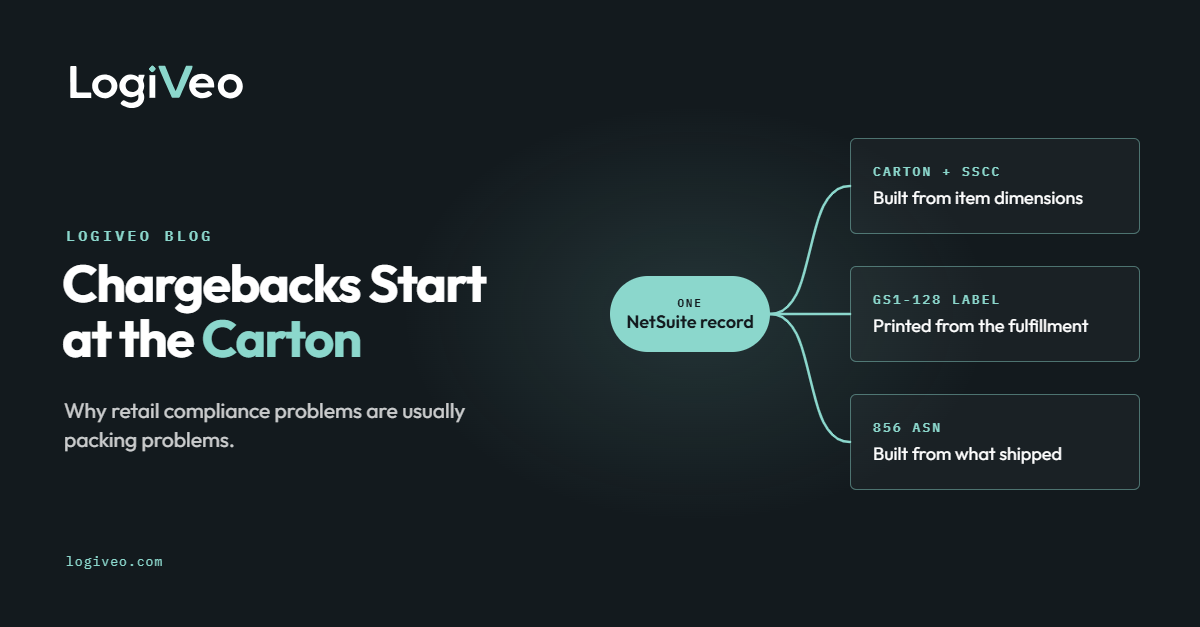
Why retail compliance problems are usually packing problems, and how to stop paying for them.
Ask a B2B shipper what chargebacks cost them last month and most can give you a number. Ask where they came from and the answer gets vaguer: a label in the wrong place, an ASN that didn’t match, a carton count that was off.
Those sound like paperwork problems. Almost always, they’re packing problems.
How a compliant shipment is supposed to work
Retailers need three things to agree: what’s physically in each carton, the GS1-128 label on the outside of that carton, and the 856 ASN that tells them what’s coming. Each carton gets its own SSCC, a serial number that ties the label to its line on the ASN. When all three agree, the shipment is received automatically. When they don’t, someone at the distribution center fixes it by hand, and you get the bill.
Where it breaks
In most operations, those three things are produced in three different places. The packer builds cartons on the floor. A label tool or EDI provider prints the GS1 labels. Someone keys the ASN into a portal or spreadsheet afterward. Nothing forces them to agree, so on a busy day, they don’t.
The labor adds up too. Working through the routing guide, labels, packing list and portal entry takes about three hours per retail shipment when it’s done by hand. And getting it wrong isn’t cheap: a missing or incorrect ASN typically draws $200–$500 per shipment, depending on the retailer.
Start at the carton
The fix is to decide the cartons once, from data you already have, and build everything else from that one decision. Inside NetSuite, that looks like this:
- The retailer’s packing rules (quantity per carton, carton type, pallet configuration) live on the customer record.
- Cartons are built from the item dimensions and those rules, and each one gets an SSCC on the fulfillment.
- GS1 carton and pallet labels print straight from that fulfillment, so the label matches the record, carton for carton.
- The 856 ASN is generated from the same record when it ships: from what actually shipped, not what was planned.
If you use SPS Commerce, keep it. The difference is that what reaches SPS already matches the cartons on your dock.
What it’s worth
For an illustrative operation shipping 150 retail orders a month, three hours of manual compliance work each comes to about $151,000 a year in labor, before a single chargeback. Avoiding just four to eight chargebacks a month typically covers the cost of automating it.
See it at SuiteWorld
We’ll be showing the full carton-to-ASN flow, inside NetSuite, at booth 743. I’ll also cover it in my session, The Hidden Cost of Shipping Outside of NetSuite, Tuesday at 2:30 PM PT, Academy 414.
Ron Bester, Founder & CEO, LogiVeo