
NetSuite has become the system of record for modern commerce, manufacturing, and 3PL operations. It manages financials, inventory, purchasing, and order management at scale.
However, when it comes to fulfillment execution and shipping optimization in NetSuite, many organizations still rely on disconnected shipping software, third-party TMS platforms, or loosely integrated rating engines.
That separation creates operational friction, data silos, and unnecessary freight cost.
As shipping volumes increase and carrier strategies grow more complex, companies need more than basic label printing. They need NetSuite fulfillment automation and embedded multi-carrier shipping optimization working together inside a single workflow.
The future of NetSuite operations depends on alignment.
The Operational Gap in NetSuite Shipping Workflows
NetSuite is exceptionally strong as an ERP and system of truth. However, many organizations layer external shipping systems, third-party TMS tools, or loosely connected rating engines on NetSuite is exceptionally strong as an ERP and financial system of truth. But shipping execution often lives outside of it.
Many companies layer:
- External shipping systems
- Third-party parcel platforms
- Standalone TMS solutions
- Separate rate-shopping engines
When shipping decisions happen outside NetSuite’s core data model, several issues emerge:
- Packing decisions are made without real-time carrier economics
- Rate shopping occurs after fulfillment is processed
- Shipment data is stored in external systems
- Financial reconciliation becomes manual
- Peak throughput creates bottlenecks
This disconnect reduces visibility and weakens cost control.
NetSuite shipping integration should not require exporting data to another platform just to generate labels or select carriers. When fulfillment and optimization are fragmented, operational efficiency suffers.
Fulfillment Execution in NetSuite Must Be Intelligent
Modern fulfillment execution is no longer a manual warehouse activity. It requires system-driven logic that connects inventory, financial data, and carrier decisioning in real time.
Intelligent fulfillment execution in NetSuite should include:
Core Components of Intelligent NetSuite Fulfillment
- System-driven cartonization
- Automated enforcement of shipping rules
- Real-time validation of service levels
- Integrated parcel and LTL workflows
- Inventory, lot, and COGS tracking tied directly to shipments
- Seamless generation of labels and documentation
When fulfillment automation operates directly inside NetSuite, execution becomes scalable. Warehouse teams do not toggle between systems. Data remains consistent. Financial records reflect actual shipping activity.
Without embedded execution, companies introduce unnecessary steps into their outbound workflow.
Shipping Optimization Should Be Embedded — Not Bolted On
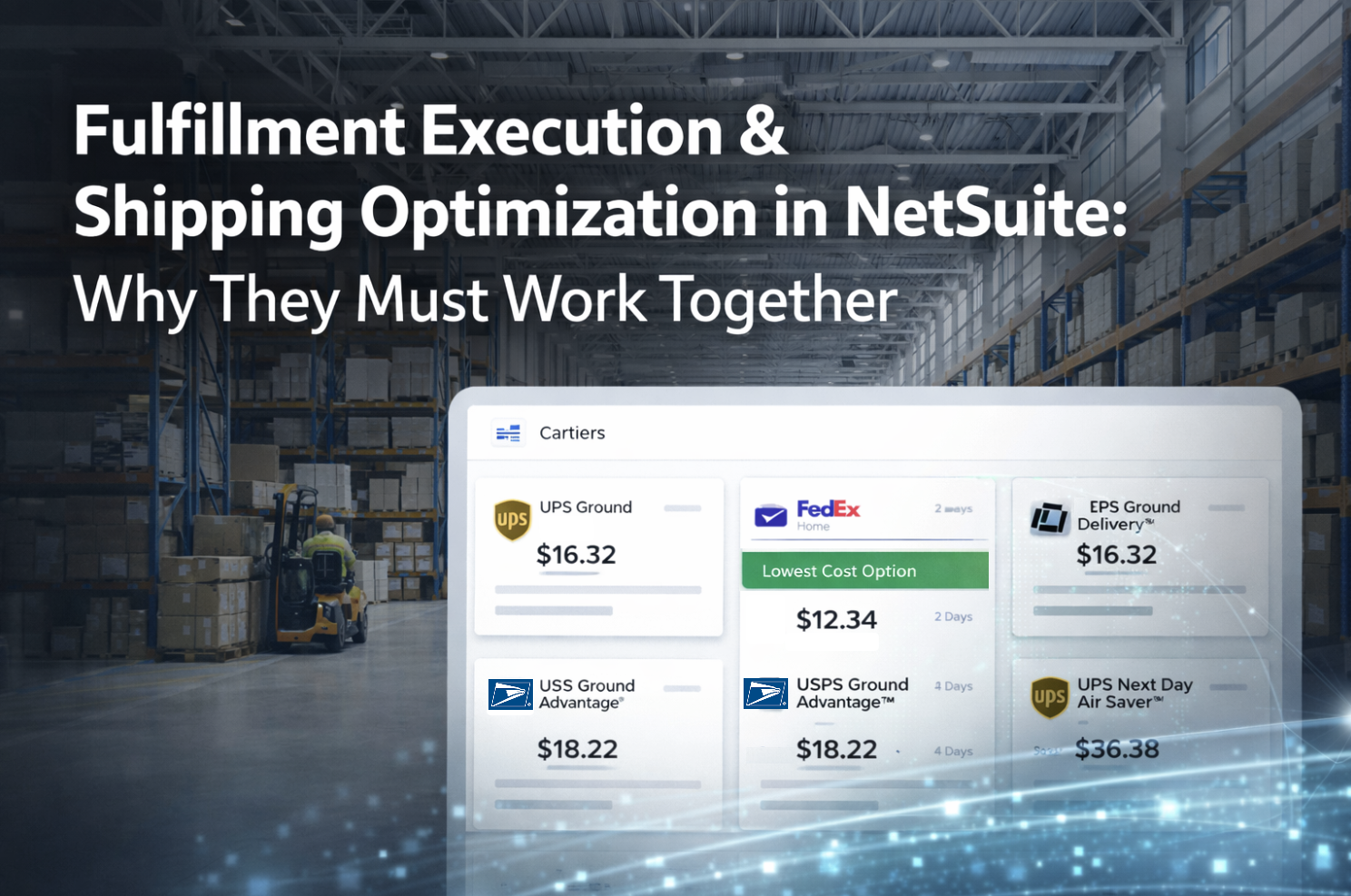
Shipping optimization is more than rate shopping. It involves intelligent carrier selection based on cost, service level requirements, performance logic, and contractual agreements.
True multi-carrier shipping in NetSuite requires:
- Real-time multi-carrier rating
- Automated service-level validation
- Carrier performance logic
- Selection of the lowest-cost option that meets delivery requirements
- Full capture of shipment and cost data within NetSuite records
When optimization happens outside NetSuite, visibility is compromised. Shipment data becomes fragmented across systems. Reporting requires reconciliation. Auditing becomes reactive instead of proactive.
When optimization happens inside NetSuite, carrier economics directly influence fulfillment decisions.
That alignment changes everything.
What Happens When Execution and Optimization Operate Separately
When fulfillment execution and shipping optimization are disconnected, friction compounds:
- Carton decisions ignore live carrier rates
- Shipping logic is applied after fulfillment is complete
- Shipment data fragments across systems
- Manual reconciliation increases accounting workload
- Operational throughput stalls under peak volume
At low volume, this separation may appear manageable. At scale, it becomes expensive.
NetSuite operators do not need more shipping tools.
They need alignment inside the system they already trust.
Why Unified Execution and Optimization Matters
When fulfillment execution and shipping optimization function as a single engine inside NetSuite, the operational model changes.
Unified workflows deliver:
- Cartonization that reflects real carrier rates
- Dynamic shipping rules applied during fulfillment
- A single system of record for shipment data
- Seamless auditability and reporting
- Scalable throughput without adding operational overhead
- Improved freight cost control
This is not just about saving money on shipping.
It is about building a scalable outbound operating model.
When shipping decisions are made in context of NetSuite inventory, financials, and order data, companies gain control.
Introducing LogiVeo Fulfillment Execution & Shipping Optimization
LogiVeo is purpose-built for organizations that require more than basic shipping functionality inside NetSuite.
Rather than treating shipping as an external process, LogiVeo embeds:
- Fulfillment execution
- Real-time carrier optimization
- Multi-carrier parcel and LTL support
- Automated documentation generation
- Full shipment data capture
Because it is 100% native to NetSuite, execution and carrier decisioning occur inside the same workflow as inventory and financial data.
This preserves data integrity while enabling scalable processing power for modern fulfillment environments.
LogiVeo transforms NetSuite from a passive system of record into an active system of operational execution.
The Future of NetSuite Shipping Integration
As shipment volume increases and carrier strategies become more complex, the gap between fulfillment execution and shipping optimization becomes more costly.
When those functions operate separately, friction compounds:
- Packing decisions ignore carrier economics
- Rate logic is applied after fulfillment is complete
- Shipment data fragments across systems
- Operational throughput stalls under volume
NetSuite operators do not need more shipping tools. They need alignment.
Fulfillment Execution & Shipping Optimization brings warehouse execution and carrier decisioning into a single, continuous workflow inside NetSuite.
Not as an add-on.
Not as a workaround.
But as an integrated outbound operating model.
At scale, separation creates cost.
Alignment creates control.
That is the shift.
Frequently Asked Questions About NetSuite Shipping Optimization
What is the best way to manage multi-carrier shipping in NetSuite?
The most effective approach is to use a fully native NetSuite shipping integration that embeds real-time carrier rating and service validation directly into the fulfillment workflow.
Why is external shipping software problematic for NetSuite users?
External systems create data silos, increase reconciliation complexity, and prevent carrier economics from influencing cartonization and fulfillment decisions in real time.
Does NetSuite support parcel and LTL optimization natively?
NetSuite supports basic shipping functionality, but advanced multi-carrier optimization, automated cartonization, and embedded rate logic typically require a purpose-built native solution.
How does fulfillment automation reduce shipping costs?
Fulfillment automation ensures carton decisions, service-level selection, and carrier choice are driven by real-time cost logic, eliminating manual overrides and suboptimal shipping decisions.